

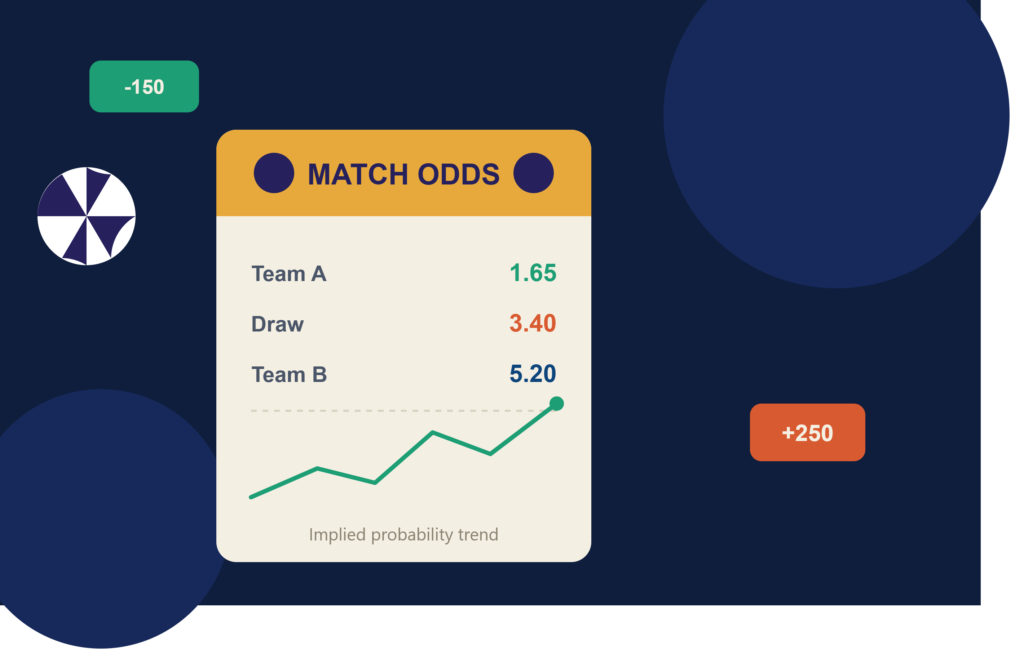
The first time I opened a betting app, I stared at three numbers next to a football match — something like -150, +130, and a decimal like 2.10 — and had absolutely no idea what any of it meant. I closed the app, googled “what do betting odds mean,” read three articles that explained it in the most confusing way possible, and gave up for about a month.
Eventually I sat down with a notebook, a small amount of money I was fine losing, and forced myself to actually learn it. This is the explanation I wish I’d found on day one.
The three odds formats you’ll actually see
Depending on which app or site you’re using, odds show up in one of three formats. Once you recognize them, none of this is complicated.
American odds look like -150 or +130. The minus sign tells you how much you’d need to bet to win $100. The plus sign tells you how much you’d win on a $100 bet.
Decimal odds look like 2.10 or 1.65. This one is the easiest once it clicks — multiply your stake by the number, and that’s your total payout (including your original stake).
Fractional odds look like 5/2 or 1/3. This is the format you’ll mostly see on UK sites. Read it as “for every 2 you bet, you win 5” (or however the numbers break down).
I personally switched my app’s settings to decimal odds within the first week, because it’s the only format where I could do the math in my head without a calculator. Most betting apps let you change this in a settings menu — usually under “Odds Format” or “Display Preferences.”
What the numbers are actually telling you
Here’s the part that took me longest to actually understand: odds aren’t just a payout calculator. They’re the sportsbook’s estimate of how likely something is to happen.
A heavy favorite — say, a top team playing a much weaker one — will have odds like -300 (American) or 1.33 (decimal). That means you have to risk a lot to win a little, because the outcome is considered likely.
An underdog will have odds like +250 or 3.50. Smaller risk, bigger potential payout, because the sportsbook thinks it’s less likely to happen.
The moment this clicked for me was when I started converting odds into implied probability. It’s a simple calculation, and once I did it manually a few times, I stopped needing the formula.
The step I actually use every time
Before I place anything, I do three things, in this order:
Step 1 — Convert the odds to a probability. For decimal odds, it’s 1 divided by the decimal, times 100. Odds of 2.00 mean roughly a 50% implied chance.
Step 2 — Ask myself if I actually agree with that number. This is the entire game. If a team is priced at 1.50 (about 67% implied chance) and I genuinely think they’re closer to a coin flip, that’s where value might exist — or where I’m wrong, which happens plenty.
Step 3 — Check the same match on two different sites. Odds move, and they’re not identical everywhere. I keep two apps installed just to compare lines before betting on anything I’m serious about. A five-minute check has saved me from taking a worse number more than once.
A mistake I made early on
My first real mistake wasn’t picking a bad team — it was not understanding that odds change constantly, sometimes minutes before kickoff. I locked in a bet, checked back an hour later, and the odds had shifted because of a late injury news update. I hadn’t lost anything, but it taught me that odds are live, reactive numbers, not fixed prices.
Since then, I check team news before finalizing anything, not just before opening the app.
Moneyline vs. spread vs. totals — the three basic bet types
Once odds make sense, the bet types are simpler than they sound.
Moneyline is just picking who wins. No point spread, no extra math — the odds themselves reflect who’s favored.
Spread (point spread) adds a handicap. The favorite has to win by more than a set number of points for that bet to pay out; the underdog can lose by less than that number and still “cover.”
Totals (over/under) is a bet on the combined score of both teams, not who wins.
I started with moneyline bets exclusively for about two months before touching spreads, mostly because I wanted to get comfortable reading odds without a second layer of math on top.
Tools I actually keep open
A couple of things made this whole process less confusing for me day to day:
- An odds comparison site, so I’m not stuck with one number
- A basic notes app where I log what I bet and why — not for strategy, just so I stop repeating the same mistakes
- A implied-probability calculator (there are several free ones online) for the first few weeks, until I could do the rough math myself
The one habit that mattered more than any of this
Set a number you’re comfortable not seeing again, and treat it as already spent the moment you place anything. That single habit did more for me than understanding any odds format ever did.
Odds explain the numbers. They don’t explain when to stop, and that part is on you to decide before you start, not while you’re mid-bet trying to be rational about it.
If you’re new to reading odds, start with decimal format if your app allows it — it’s the easiest to do in your head, and everything else in this guide gets easier once that one thing clicks.