
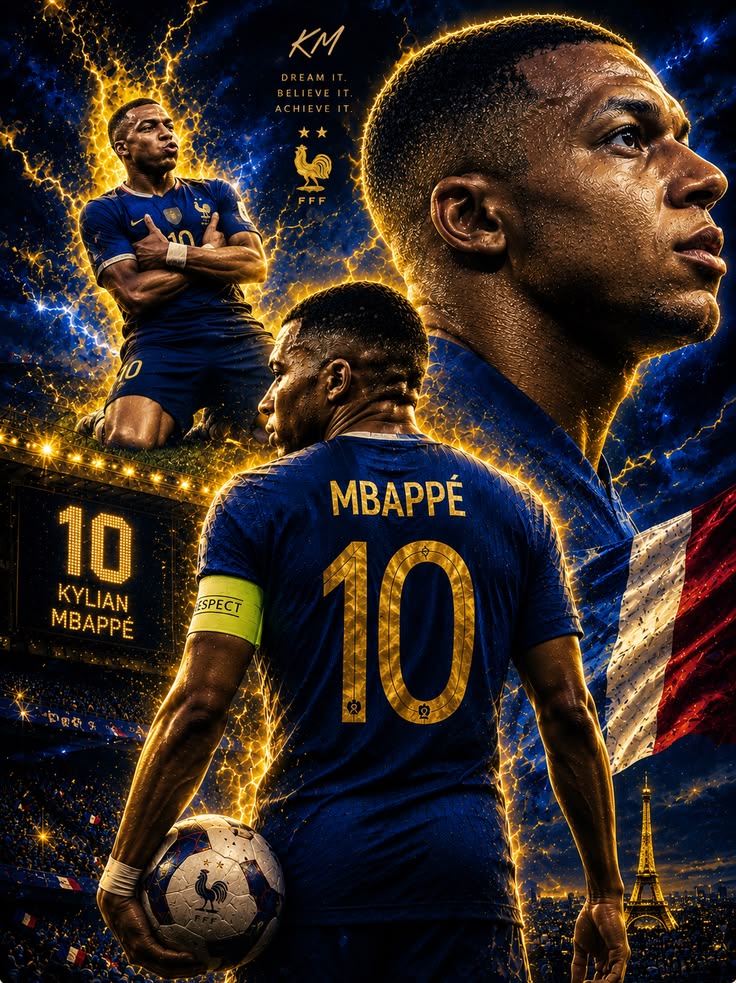
I followed this story closely because it had a familiar shape to it — a star player picks up a knock, the club says he’s fine, then a training session raises new doubts, and the cycle repeats. Except this wasn’t a random midweek fixture. It was the days leading up to a World Cup semifinal, which meant every training update got scrutinized far more closely than it normally would.
Where the injury actually started
Mbappé’s ankle problem wasn’t new when it flared up before the Spain semifinal — it had a history stretching back months. He’d first hurt the same ankle playing for Real Madrid against Villarreal, then aggravated it again in a France World Cup qualifier against Azerbaijan, limping off in the 83rd minute despite scoring in that match. The injury was serious enough that Deschamps pulled him from the following qualifier against Iceland entirely, telling reporters bluntly: “There was no risk to take.” Notably, that same qualifying match against Iceland — the one Mbappé missed — was the only game France failed to win throughout the entire qualifying campaign, a small but telling data point on just how much France’s results lean on his presence.
That history is important context, because it meant nobody around the France camp was treating this as a fresh, one-off knock once it resurfaced at the World Cup.
The scare that reignited it
The immediate trigger for the pre-semifinal panic came in France’s quarterfinal win over Morocco. Mbappé was substituted in the 77th minute after taking what he described afterward as a “minor ankle injury” — the same ankle that had already caused him to miss international fixtures earlier in the year. He downplayed it immediately, calling himself “completely fine” in his post-match interview.
That reassurance didn’t fully settle things. Reports in the French press, including from RMC Sport, suggested he was still carrying discomfort in the days that followed. Then, during Monday’s open training session — two days before the semifinal — Mbappé trained separately from the rest of the squad for part of the session, which was enough to reignite the exact concerns his post-match comments had tried to shut down. For a story that had already cycled through reassurance once, a second wave of doubt this close to a semifinal was always going to dominate the pre-match narrative, regardless of how minor the actual issue turned out to be.
Deschamps’ response
Deschamps didn’t dodge the question when it came up in his pre-match press conference. Asked directly about Mbappé’s fitness, he was blunt: “Kylian is fine… He is at 100 per cent. We can’t go beyond 100. He is at 100 per cent.” He also gave a specific, almost dismissive explanation for the separate training session, joking that Mbappé simply “has the right, like others, to go 15 minutes instead of 20 minutes on a drill” — later clarifying Mbappé had actually completed ten of a planned fifteen minutes on one specific exercise, not skipped training altogether.
Medical analysts covering the story from the outside estimated the injury was most likely a Grade 1 ankle sprain, consistent with Mbappé’s own “minor” description — the type of injury that typically doesn’t prevent a player from featuring, but can reduce their elite sharpness and carries some elevated re-injury risk if not managed carefully. That distinction between “won’t stop him playing” and “won’t affect how he plays” turned out to be the real crux of the entire story — nobody seriously expected him to miss the match, but whether he’d be fully himself once he was out there was a different question entirely.
Why this mattered so much for France specifically
This wasn’t just star-player paranoia. Mbappé had either scored or assisted eleven of France’s sixteen goals at the tournament to that point — a genuinely enormous share of the team’s attacking output for one player to carry. Losing him, even partially, would have been a completely different kind of problem than a normal squad-depth injury.
He also wasn’t France’s only fitness concern heading into that match. Midfielder Aurelien Tchouameni was still working back from a thigh injury suffered earlier in the tournament and wasn’t fully ready to start, while Manu Kone — the presumptive backup option in midfield — was carrying his own knock from the Morocco match after being withdrawn with an apparent knee issue. Deschamps was managing an unusually fragile squad heading into the biggest match of the tournament so far, with fitness concerns stacking up across multiple positions rather than being isolated to one player.
What was actually at stake individually
Beyond the team picture, Mbappé had his own significant personal stakes riding on his fitness. He entered the semifinal tied with Messi at eight goals in the Golden Boot race, holding the tiebreaker lead on assists. He was also closing in on history — sitting at 20 World Cup goals across three tournaments, trailing only Messi’s record of 21. Playing at anything less than full fitness against a Spain defense that had conceded just once all tournament wasn’t just a team risk; it was a genuine threat to both of those personal milestones.
Mbappé’s career-long relationship with this specific type of storyline is also worth noting — he’s dealt with recurring fitness scares at previous tournaments too, and each time has managed to play through them at a level that quiets the doubters, at least temporarily. That track record is likely part of why Deschamps felt comfortable being so unequivocal in his press conference, rather than hedging his answer the way managers often do with genuinely uncertain injuries.
How it actually played out
Mbappé did start the semifinal. France lost 2-0 to a Spain side that controlled large stretches of the match, and while it’s impossible to say definitively how much the lingering ankle issue affected his individual performance, France’s overall attack — so heavily dependent on him throughout the tournament — didn’t produce enough to trouble Spain’s defense. Whether that was the ankle, Spain’s defensive discipline, or some combination of both is the kind of question that gets debated well after the fact, without a clean answer.
What is clear is that the week of uncertainty leading into the match — scare, reassurance, fresh doubt, firm denial — became as much a part of the semifinal’s story as anything that happened in the 90 minutes itself. It’s also a reminder of how differently these stories get read in hindsight: had France won that semifinal, this injury saga would likely be remembered as a footnote about Mbappé playing through pain to deliver for his country. Instead, it lingers as one of several open questions about whether a fully fit France might have told a different story against Spain.
Sources referenced: Yahoo Sports, beIN Sports, Goal.com, Sports Illustrated, and Forbes coverage of Kylian Mbappé’s fitness ahead of the 2026 FIFA World Cup semifinal.