
I went looking for a “list of sports” a while back — I wanted something I could actually use to figure out what category a sport I was writing about belonged to. What I found instead was a wall of alphabetized names, hundreds of them, with zero structure. Archery next to Australian rules football next to badminton. Useful if you already know what you’re looking for. Useless if you’re trying to actually understand how sports relate to each other.
So I built the version I wish I’d found: a sports list organized the way it should be — by category, with the logic explained, not just names in a row.
Why alphabetical lists don’t actually help
[Image: side-by-side comparison of a plain alphabetical sports list vs. a categorized one]
Here’s the problem with most “list of sports” pages: alphabetical order is organized around the letter a word starts with, which tells you nothing about the sport itself. It’s the equivalent of organizing your kitchen by the first letter of each ingredient instead of by what you’d actually cook with it.
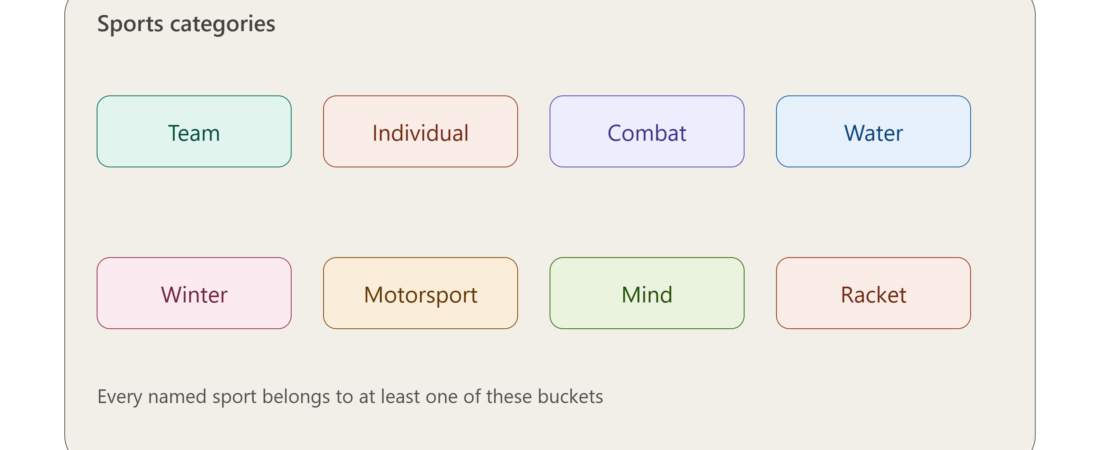
A categorized list solves that. Once you know a sport’s category, you know a lot about it already — how it’s scored, whether it’s a team or solo pursuit, how physical contact factors in. That’s the structure I’ve used below.
Team sports
These are sports where the fundamental unit of competition is the group, not the individual — soccer, basketball, rugby, cricket, volleyball, ice hockey, American football, baseball, and handball are the ones you’ll run into most.
If you’ve read my breakdown of the “Big Four” American leagues, you’ve already seen how much this category alone shapes entire sports economies — football, basketball, baseball, and hockey are all team sports, and that’s not a coincidence. Team sports tend to dominate media revenue precisely because they generate ongoing storylines: rosters, rivalries, seasons.
Individual sports
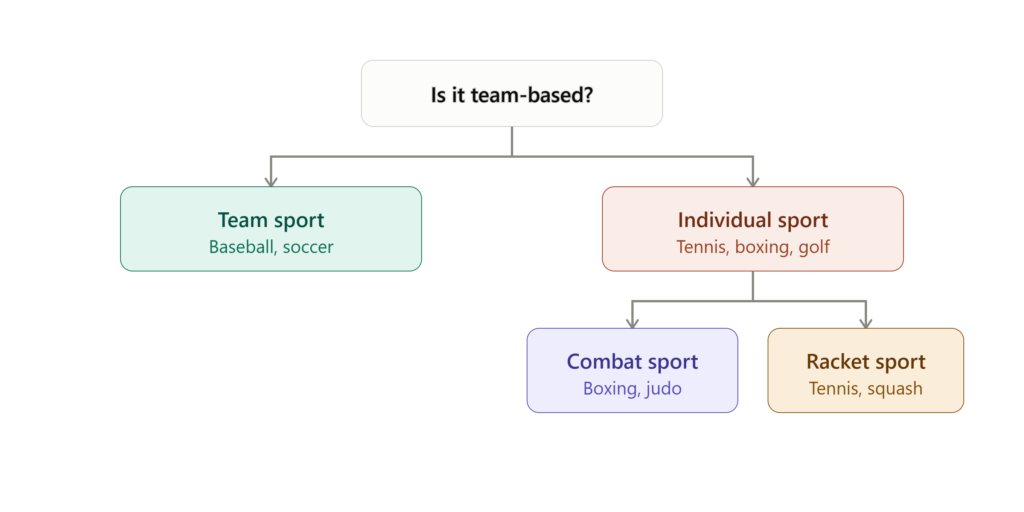
Here, one athlete competes alone, even when the event has a team component layered on top of it (like how tennis has singles matches but also doubles, or how the Olympics tallies individual medals by country). Athletics, golf, gymnastics, cycling, swimming, and figure skating are the classic examples.
I found this category genuinely underrated while researching what’s actually the hardest sport in the world — individual sports don’t get the difficulty credit team sports do, but sports scientists rate several of them (gymnastics especially) extremely high on pure physical demand, precisely because there’s no teammate to cover for a weakness.
Combat sports
Boxing, wrestling, judo, karate, taekwondo, MMA, and fencing all fall here — sports built around direct physical confrontation between two competitors, governed by strict rules about what contact is allowed.
This is the category that keeps winning “hardest sport” rankings, and after researching it properly, I understand why: combat sports uniquely combine physical conditioning with a mental component (facing an opponent trying to physically beat you) that most other categories simply don’t require.
Racket and dual sports
Tennis, badminton, squash, table tennis, and pickleball belong here — head-to-head formats using a racket or paddle to hit an object back and forth. It overlaps with individual sports (most racket sports are played solo, though doubles formats exist), but it’s specific enough that it deserves its own bucket.
Water sports
Swimming, water polo, rowing, sailing, surfing, diving, and kayaking all use water as the actual field of play, not just a setting. This is one of the more physically varied categories on this whole list — everything from pure endurance (open-water swimming) to team combat-adjacent physicality (water polo, which regularly ranks near the top of “hardest sport” scoring models for exactly that reason).
Winter sports
Skiing, snowboarding, ice hockey, figure skating, bobsled, curling, and speed skating — anything built around snow or ice as the competitive surface. Most of what defines the Winter Olympics falls here, and it’s a category that barely overlaps with any other on this list, since almost nothing about summer sport training translates directly to competing on ice.
Motorsports
Formula 1, NASCAR, MotoGP, rally racing — sports where the athlete’s vehicle is as much a part of the competition as their own physical skill. This is the category people argue about most in “is this really a sport” debates, precisely because the physical demand is real but less visible than in other categories (extended G-force exposure, heart rates comparable to other elite endurance sports, all inside a machine most viewers never see the inside of).
Mind sports
Chess, esports, bridge, and competitive Scrabble sit in a category that pushes the definition of “sport” the hardest — minimal physical exertion, but genuine competitive structure, governing bodies, and in chess’s case, Olympic recognition consideration. Whether you count these as “real” sports is genuinely one of the more contested debates in the space, similar to the debate I found digging into what actually counts as one of the top 5 physical games in the world — mind sports specifically get left off physicality-based rankings for exactly this reason.
The category that swallows everything else: hybrid and niche sports
Beyond these core groups, there’s a long tail of sports that blend categories or don’t fit cleanly anywhere — triathlon (individual + endurance + multisport), biathlon (winter + shooting), modern pentathlon (five disciplines in one event), and genuinely obscure entries like buhurt (armored medieval-style combat) or ice canoeing. Some estimates put the total number of distinct sports and sporting games played worldwide at well into the thousands once regional and indigenous games are counted — nowhere close to the couple hundred most “list of sports” pages bother naming.
Why this actually matters, beyond trivia
Understanding sport categories isn’t just organizational tidiness. It’s the actual lens serious rankings use — when ESPN built their Degree of Difficulty grid, they were implicitly comparing across categories (a combat sport against a team sport against an individual sport), which is exactly why the results sparked so much argument. You can’t fairly compare a mind sport to a combat sport on “difficulty” without acknowledging they’re measuring almost completely different things.
Next time you see a “top 10 hardest sports” or “biggest sports leagues” list, check which categories it’s actually pulling from before you take the ranking at face value. That context is usually the difference between a list that’s genuinely useful and one that’s just names in a row.
Sources referenced: Wikipedia’s Category:Sports by type, Category:Individual sports, List of major achievements in sports by nation, and additional sports classification references.